History
In the 1930s, Eagle County Regional Airport originated as an emergency landing strip for a Denver to Los Angeles air route. Fast forward to September 14, 1947, when the airport was officially dedicated, serving as a hub for general aviation. By 1989, it saw 277 commercial passengers, a number that skyrocketed to 320,111 in 2015.
The evolution of the airport continued in 1996 with the unveiling of a $9 million, 36,000 sq. ft. passenger terminal, marking a 73 percent increase in passengers during that season. High demand prompted an additional 30,000 sq. ft. expansion in 2001, anticipating the growing popularity of commercial air service to EGE.
On November 19, 2003, a significant milestone was achieved with the opening of a $2.2 million airport traffic control tower, replacing a 43-foot temporary tower. In 2006, an Instrument Landing System (ILS) was commissioned, followed by the addition of a BI-6 radar system in 2007, enhancing the airport’s capabilities in lower visibility conditions.
The airport’s runway received a substantial upgrade in 2009 with a $40 million extension and rehabilitation project, extending the runway to 9,000 ft. This extension allowed aircraft to take off at heavier weights, increasing their range.
In 2012, a security checkpoint expansion project was completed, doubling the number of passenger screening lanes from 2 to 4. Alpenglo Express also opened, providing passengers with a pre-security option for food and retail.
2013 marked a noteworthy achievement, positioning Eagle County Regional Airport as the second busiest airport in Colorado by peak day passenger traffic. A study commissioned by the Colorado Department of Transportation Aeronautics Division in the same year highlighted the airport’s substantial economic impact, totaling $635,900,000 and creating 6,294 jobs with $217,500,000 in wages.
2014 saw the completion of a master plan update, outlining the airport’s 20-year plan to cater to current and future users. The subsequent year, a Snow Removal Equipment building was constructed to ensure the proper storage, maintenance, and longevity of EGE’s snow removal equipment, along with providing additional training and office space.
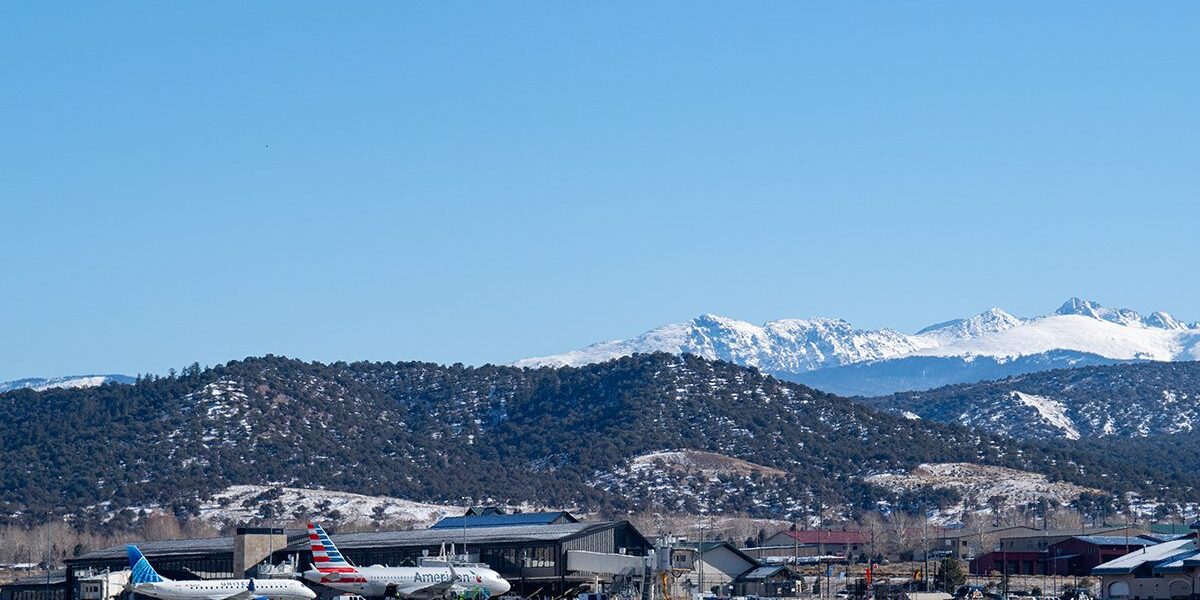
Fast forward to 2019, the completion of the Terminal Expansion project marked a new era for the airport, expanding the gate area and introducing amenities like a pet relief area, jet bridges, a larger restaurant and bar, private nursing area, and a touchless experience in the restrooms.
Served by four major airlines — American, Delta, United, and Alaska — the airport provides nonstop winter service to key hubs across the United States, ensuring excellent connectivity worldwide. Moreover, year-round service features nonstop flights to Denver and Dallas, offering convenient travel options for passengers throughout the year.